winter 2018 tasting notes
And it is good. California is a land of natural terrors right now: mudslides follow fires which followed drought, which followed abundant Spring rains nearly a year ago. The fires north and south have left hillsides exposed, denuded of the vegetation that would otherwise hold rain-soaked soil in place. The rains that began Monday are nonetheless deeply welcome: they are part of the natural cycle that we long ago came to expect and to depend on, and even if they erode soil, they are so much better than drought. And it is not just wet; it is cold. And the cold is good too: we all require some degree of dormancy; it is wonderful how the cool, damp weather makes us all move differently. We cast long, slow shadows in the dim light.
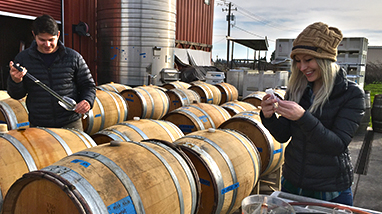
Alex and Brenna and I gathered at the winery yesterday to taste our 2017 wines for the first time together. We believe so strongly in letting the recondite internal dynamics of the wines, both biological and chemical, progress on their own that we really minimize not just intervention, but tasting! There is some kind of huge change that takes place in the first few months after harvest, and if you keep tasting the wines constantly as they progress, you deprive yourself of the wonderful and somewhat strange experience of tasting the wines for the first time as wines. You put them to bed at the end of harvest, and you walk way. And when you return, after the Solstice, they are no longer unformed, or germinating, or transforming every-day—they are now distinct and clearly on the way to some final shape and character.
Some of the wines had been problematic when we walked away; some had merely seemed not so distinct or promising; one crucial wine—the Prince—went through such a such a strange phase after harvest that all you had to was graze a barrel in passing and the wine would announce its difficulties. I arrived at the winery full of anticipation and excitement, but with a little demon of trepidation sitting insistently on my shoulder.
Let me offer an introduction to the vintage: It was lovely for us; kind
of perfect. Everything
began well. The Spring rains slowed many of the physiological moments
that had propelled the
beginning of harvest into July during the drought; this year, we began
picking in August, and
worked slowly and without hurry. And though the rains were abundant,
they did not lead to
excess
fertility in our vineyards; everything was in balance from the
beginning.
Ripening was slow and even. For the first time ever, we were not rushed
to harvest a single
vineyard, in east or west, because of a heat-spike. No roasting on
hillsides, no panic to
avoid
damage. Nor did our vineyards stall, neither did cold nor rain threaten
steady progress. And
we
were so fortunate: not only had we harvested all of our fruit before the
fires broke out, but
we
had even barreled down every fermentation but one.
The winery microbiome was helpful too: the fermentations were almost all good, and easy. As you know, every fermentation is spontaneous; we never use commercial yeast. And each is nearly autonomous: we allow them to progress pretty much without intervention or encouragement. This regime is not without peril—two of the four Prince fermentations this year seemed to be governed by some unfamiliar host of microbes; one of the VDK fermentations veered terribly toward vinegar early in its life. Our solution in each case was to punchdown the caps, changing the distribution of microbes in relation to the mass of the wine and the exposure to oxygen. In each case, it seemed to help. Both fermentations finished; on the whole, this easy collaboration with our winery microbiome is what allowed us to tuck everything in early. But recollecting these two challenges these helped feed my trepidation going into the tasting.
We began with the first fruit of the year, and it was also the most brilliant and beautiful wine of the whole vintage. Because it was so good, a difficult place to start: FTP-C; young vine Chenin from Tegan Passalacqua's Kirschenmann vineyard. The wine has the depth and nobility of Loire Chenin from Saumur, and absolutely remarkably high acid given its origin on the sands of Lodi. The sand is no doubt crucial; the vineyard is in an alluvial bow the Mokelumne; there is no low-land loam, but only ancient quartz washed down from the Sierras. I will not give you a complete report on all of the wines—instead of this, you should simply visit us. Please do.
But I cannot resist brief notes on some of the wines; including some of the over-wintering wines from 2016:
It was a good day. There is so much else to tell you. More next week. I will head back to Los Angeles then and will have more news for you from the banks of the river. And I am hosting a champagne and martini speakeasy with friends who are devoted to cocktails—and hospitality.
Come to the winery. Come to the now verdant hills that surround us.