spring 2013 release
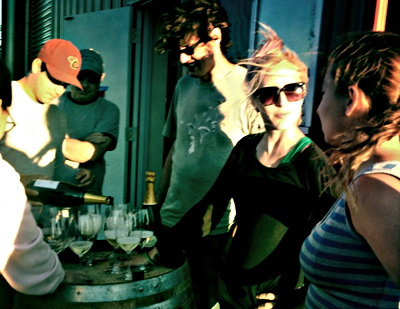
Twelve wines—several that represent the first revealed creations of the annus mirabilis of 2012, and four reds, stretching from 2009 to the precious Chuy of 2011.
This is very exciting for us—our first Naucratis since 2009! The quality is excellent; as beautiful as that year, and as powerful. But 2012 was a very special year of low alcohol and perfect ripeness; so the wine is ighter on its feet than it has ever been, but no less complex and intense. a great source of pleasure. As always, stainless-steel fermented, limited malolactic, limited lees contact. Crisp, clear, direct. 137 cases
We got no fruit from Lost Slough in the difficult year of 2011. This is our first Riq since 2010. We made an experiment this year, based on smaller experiments in previous years. We fermented 100% of the wine in neutral barrels, and aged it in the same for 5 months. The wine is very powerful and bass-driven. It has no floweriness, certainly no pot-pourri. Instead, it has a high-degree of minerality, and though it is a very clean wine, it has the funk of gewurz. Still great for the dance floor. 265 cases of 500 ml bottles
This is our first wine from the vineyard of our dear friend and teacher, Tegan Passalacqua. The vineyard is located on the beautiful banks of the Mokelumne river as it flows through the sandstone soils of eastern Lodi. The vines are 35 years old and consist of Pinot Gris. We fermented the wine with 15% whole clusters submerged in the juice; the result is copper in color but not tannic in feel. The wine is delicate and subtle, with the surprising high acidity of older vines on good soil in Lodi. (The acronymic name of the wine descends from a hallowed tradition of giving a wine the grower’s initials as a designation in the winery; the prefix “F” indcates the intensity of respect and affection. 36 cases
The fruit of the amazing 127 year-old Bechtold Ranch Cinsault ripened early this year with extraordinarily rich flavors. We made the wine this year with an absolute minimum of skin contact, aiming for a blanc-de-noir, but the vintage is determining the wine, not us. The wine is some rose, as the 2010 was, and riper and richer (though at lower alcohol) than the 2011 was. One still does not taste red fruit; instead, vibrancy, sharpness, power all at once. 265 cases
One hesitates to give the cry of “Wolf” once again—at the end of harvest, the Mcdowell brothers assured me that they will allow the few remaining Sauvignon vines of Glos to persist for another year. So the 2012 will not the be the last, but the penultimate harvest from this amazing old-vine vineyard. The wine this year is perfect; the most beautiful since 2009. The fermentation has been very slow, and is just finishing now, during the unexpected cold of winter. The wine remains light and fresh, but is powerful and substantial—the manifestation of the nobility of old vines. 30 cases (our biggest harvest ever!)
This is a new blend for us. Midan al-Tarhir went in a certain directlion, founded on fruit from Markus Bokisch’s hillside Verdelho vineyard. We blended the wine from that fruit because I had never succeeded in making a wine from it that I thought was equal to the vineyard. Thus Midan, a blend meant to give that fruit a home. This year, we finally got the vineyard right and have made an excellent single-vineyard wine. Our blend returns to a wine we have not made since 2008. Previously, the wine has come exclusively from Lost Slough; this year, we revive the name for a very interesting wine devoted to displaying phenolic intensity, acidity, and minerality with a minimum of skin contact. The blend is a majority Chardonnay, all from Tenbrink. The rest is Verdelho, with a little Cinsault and Pinot Grigio; al from 2012. The wine was fermented in barrel, but aged only 5 months, with limited malo-lactic fermentation. I think that the wine is recognizably Chardonnay (which does not sound like praise) but has excellent acidity, a tannic grip, Lodi minerality, and no butteriness. 288 cases
We have finally made a wine equal to the stunning potential of Markus Bokisch’s hillside Verdelho vineyard in the Borden Ranches section of Lodi. The vineyard is supremely rocky and full of iron; cool wind flows down from the nearby Sierras to keep the vines cool as the fruit ripens. This year we pressed the fruit very carefully and minimized both skin and oxygen contact. We fermented in barrel, but have kept the barrels topped during the 5 months of maturation, and we have prevented complete malo-lactic fermentation. The wine is very sharply etched, with persistent minerality and a severity that makes the head snap back. This is the first wine that we show in the cellar; it is our pole start for excellence in the winery. 20 cases
2011 was nearly a year of true bounty in the Guman’s vinyard: our largest harvest since 2002. Years of careful pruning and shoot selection, since the catastrophic harvest of 2008, had finally paid off. And the quality was excellent too: very intense, tannic fruit; coming in with its slightly pumpkin-y sun tan. The fermentations were rapid—but, for reasons that I will never understand, two baby barrels spoiled immediately after harvest. We saved one of them through refermentation, but another sits sadly in the winery, with a blue-tape skull and cross bones on it. Everything that comes from the vineyard is so precious that I cannot bring myself to destroy the barrel, but the wine is so profoundly spoiled that now it has no home. The rest of the wine is a Sylphian triumph: flor-affected, deeply nutty, rich, precise. 75 cases
This is one of our two Wines of Terror. You might remember my end of harvest report from 2011, when there was metaphorical blood on the ground, and rotting fruit going un-harvested. We brought in all of our Hudson Syrah, and all of it was botrytised to some degree and spotted with other interesting molds. We nonetheless made wines that we were very proud of— post fermentation. As many of my friends had warned me, the maturation of these wines in barrel might revreal flaws hidden in the glow of youth. And, in fact, from our tiny production of 4 barrels, two must be declassified to Gardens of Babylon. One is superb, and will become 2011 Golgothat. The other is very good, a worthy successor to previous vintages. The truly difficult character of this vintage shines through even this very good wine: it is more delicate than other years, less meaty. But it is beautifully perfumed, and well-balanced and restrained in the mouth. So worth harvesting the fruit, capturing the nature of this harrowing vintage. 24 cases
This is our second wine of Terror. Steve Tenbrink wanted to try to save the fruit of his vineyard from the devastation that he deemed inevitable, and tried ot convince me to harvest early in October, before the third rainstorm of the year would hit. I insisted that we wait, and he listened. We harvested fruit nearly a month later, ripe in the best way, mature, complex, layered. But wtih 100% botrytis. My section of the vineyard, dry-farmed and farmed organically, was over-run. We really had no idea what to do with the fruit. After two or three days of cold-soak, a remarkable head of cheese-mold developed on the fruit. It was a couple of inches deep and thick! We decided not to break it up and just to let it sit on top of the fruit— so no punchdowns, no pumpovers. The tank smelled wonderful— like a combination of blackberry pie and triple-creme cheese. We allowed the fruit to macerate undisturbed and fermented the wine with a floating cap for 45 days. During that time, we pumped the tank over twice—not 4 times a day, but twice in 45 days. The resulting wine is astonishingly powerful—but very light on its feet. There is no senstation of rot; just power. The cool of the vintage shows in the high acidity of the wine; in other respects, the wine is quite typical. The blend this year also includes Cabernet, Syrah, Cinsault. It is dark and powerful, completely ripe, but very different from any other vintage of this wine. The year is captured in it.
2011 was a perfect year for the Nelligan Road Ranch. The Fall was cool there, as it was all over the pacific northwest, but the vineyard is high altitude and west-facing— so it is bathed in a constant breeze from the Pacific, and warmth from the afternoon sun. Rot was never a problem here, and we let the fruit hang and hang without danger. As always, the vintage is light, delicate, graceful. This is never a muscular Cabernet. Even in full ripeness, it hearkens back to another time in Northern California. 72 cases
This is a very special wine; really not a Scholium wine at all. Jason Berthold is a dear friend who helped me make my 2005 and 2006 wines; in 2006 he began making wines on his own and then continued until 2010. We always worked together, and I learned much from him. He has decided to go no further in making and selling wine, and instead to concentrate on his young family and his already established career as a chef. Now that he has pulled back, he has asked me to shepherd his existing wines. This is the first of two that I willl release; both are Syrah blends from Ann Kraemer’s Shakeridge Ranch. This is a vineyard blend, harvested at once and cofermented, using the same floating cap technique that I later used for my 2011 Gardens of Babylon. The wine has aged in neutral oak for 3 years with a minimum of topping and SO2. The wine is delicate and sophisticated; much more like Pignan than like any of the Schoium red monsters.
You may download a PDf of the release here. And you may purchase the wines here.