fermentation dynamics: late 2013
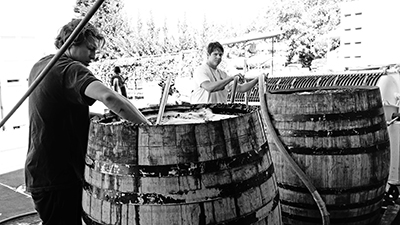
I will try to tell this story clearly and concisely. For years, we have made use of the same practices in the winery when we receive red fruit at the end of the season: we do almost nothing. We stomp on the fruit or destem it, we put in puncheons, or into wooden tanks, or, once a year, into a large stainless tank, and we chill the fruit for about a week. Fermentation either initiates on its own, or we hasten it by heating the whole system. If it starts on its own, we heat the whole anyway—to about 90 F, and then let the fermentation take off.
In 2007 and once or twice since then, we have allowed the fermentations to get too hot, and we have either pasteurized our systems during the heating process, or given them such a head start of heat that wnen the yeast take off, they reproduce so quickly that they kill themselves in their frenzy. We have almost always had success restarting these fermentations simply with fresh fruit.
Last year, for the first time, we could not restart the fermentations. And they did not simply stall, they spoiled. Bacteria produced huge amounts of acetic acid, poisoning the environment for the yeast. We will destroy some of the red wine that we "made" in 2012; we are saving the rest of it right now through refermentation. But that is another story.
This year, all of our early season fermentations went swimmingly. But the VDK fruit that we brought in for Pergamos stalled almost right away. And we detected terrible amounts of acetic acid. My old friend and colleague Johanna Jensen suspected that malo-lactic bacteria were getting in ahead of the yeast and pushing them out. Genetic analysis by a local lab supported this hypothesis.
We instituted a few simple and basic changes to our protocol; simpy putting into effect the very methods that my teacher, John Kongsgaard, had wisely imparted to me years ago, and uses still today with his son, Alex. We added 35 parts per million of sulfurous acid to the fruit before or during the cold soak. This inhibited the growth of bacteria and dimished the growth of non-winemaking yeasts and promoted winemaking yeast (probably of commercial origins). When the fermentations started, we added nutrients for the yeast to encourage rapid reproduction and the production of large numbers of yeast—to create a population of yeast as large as possible to eat the sugar as quickly as possible.
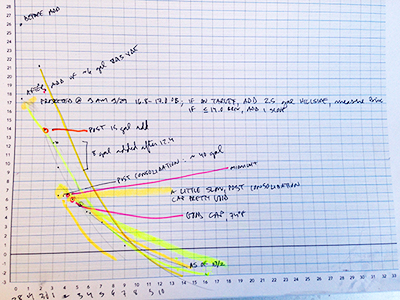
On the left, you will see four fermentation charts that record measurements that we began taking up to 4 times per day—after the Pergamos fermentation had failed. The top one shows the course of the refermentation of the failed Pergamos—the result of beginning a new fermentation, following the Kongsgaard protocols, with Wolfskill Cabernet, and slowly adding stalled Pergamos to the Cabernet as the fermentation took off. You can see that it should finish sometime early next week. Its curve is slower than the most vigorous of fermentations, but not uncommon for an uninoculated fermentation.
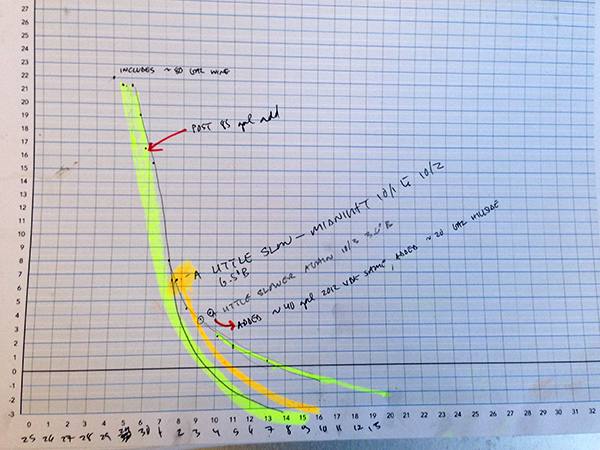
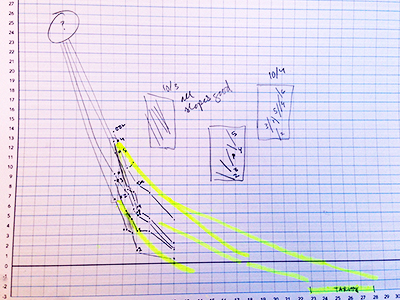
Below it, you will see the complex chart for the 5 Androkteinos and one Golgotha. You can see that the initial fermentation was very fast and vigorous, but that there were some hiccups in the middle. This is the fermermentation that seemed to simply stop with about 8% residual sugar. Once I graphed its progress, I realized that the visual phenomenon that I had observed (no cap) did NOT correspond to a complete cessation of yeast activitiy. Instead, it was the quick result of a pause in the dynamics of poplulation growth and succession. See the notes of a local scientist who looked at our genetic analysis and compared with my fermentation narrative:
I would suspect that both of these fermentations had elevated levels of Hanseniaspora dominating the early fermentation. The description of the whole cluster Syrah starting and stopping, with the cap collapsing, indicates a strong non-Saccharomyces fermentation in the beginning, and then subsequent native Saccharomyces cerevisiae had difficulty with the fermentation conditions (possibly nutrient depleted and or some type of competitive/inhibitory factor from the other native microbes. Most likely, the slowing down/stopping and restarting of the fermentation was an indication of the sequential transition in yeast strains driving the fermentation. If the Saccharomyces cerevisiae were at low numbers, it may have taken them a while to build to a sufficient population to drive the fermentation. Meanwhile, the non-Saccharomyces yeast dropped out around 6-8% alcohol (10-13 brix drop) resulting in an overall reduction in CO2 production until the S. cerevisiae started to drive the fermentation.
In regards to the level of bacteria, the elevated levels of acetic acid bacteria won't necessarily correspond to levels of VA production at this time. During cold soak, the levels of bacteria and native yeast can increase dramatically. Acetobacter produces VA by enzymatically converting ethanol to acetic acid. If there is no ethanol, they don't make acetic acid. During fermentation, the must/wine environment is generally anaerobic, preventing acetic acid production by these bacteria. Once the wine reaches O2 levels equivalent to approximately 50% atmospheric saturation with air, they can start producing VA. It would be a good thing to baseline the bacteria levels going into the barrel. If you have large populations of Acetobacter in the barrel, you will have to be very aggressive at minimizing headspace/evaporation/topping to prevent VA formation. Lastly, the Lactobacillus kunkeei will convert any remaining sugar at the end of malolactic fermentation to lactic and acetic acid and CO2. They can produce 0.2-0.3 g/L of acetic acid per g/L of fructose.
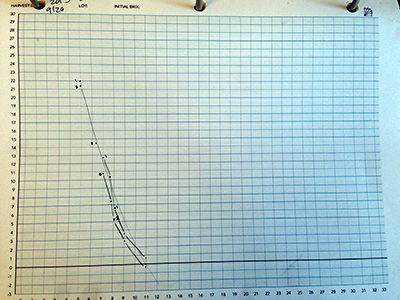
Finally, at bottom, the chart of the first fermentation to begin completely after a rigorous application of the Kongsgaard protocol: 2013 Babylon, fermentiing quickly, vigorously, and nearly dry as I write this.
The most interesting thing: genetic analysis reveals that this fermentation is absolutely rife, suffused, with spoilage bacteria. Numbers that would make an oenologist shudder, break into a cold sweat. Yet the fermentation is perfect. Everything is new each day.