Learning: in three parts
It has been an amazing month and there is so much to tell you. We are devoted to learning, study, exploration, and I can say with certainty that it has been the greatest month of learning and exploration for me since I have begun this enterprise. So you will forgive me for an uncommonly long missive.
I am going to create a winery in Los Angeles, on the banks of the Los Angeles river, on the edge of what was once the greatest grape growing region in the whole country. I aim to have this winery up and running by harvest 2015. I have made great progress already and will devote much of the month of July to finishing the plans and assembling the necessary investment. I will tell you more about this in time (it will not simply be "Scholium South" but will be an independent entity) but this is the most amazing thing: the grapes are there. I have already set my heart on more than half a dozen vineyards from the mountains of San Diego County, to the vast concrete and asphalt suburbs east of Los Angeles, to the peaks of Olympian wealth in Malibu. We will not rely on the vineyards of Santa Barbara and north whose excellence is already well established. The south is full of amazing vineyards and I knew nothing about them.
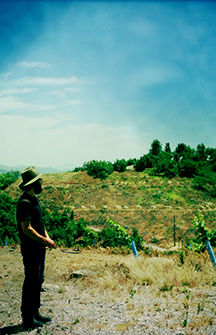
The two most important stories that I need to tell you are about a young winemaker in San Diego County and an ancient vineyard in Rancho Cucamonga. Jon Bonné, devoted student of what is old and new in California, introduced me to both. Christopher Broomell is the descendant of six generations of farmers in Southern California. Alysha Stehley, his wife, is from farming roots as venerable and significant as Chris'. Together they have won the complete trust and support of their families and have created the most remarkable winemaking operation I have seen anywhere.1
They look like kids but have a sensitive and nearly encyclopedic knowledge of vineyards that stretch from the San Diego coastline to granite outcroppings at 2500 feet of altitude, 30 miles inland. They are uncompromising to such a degree that one could call them merciless. They have made allies and won the respect of colleagues with two generations' more experience than they have. And they seem to be unbounded in their ability to imagine new vineyards where others would never have dreamed of them, or to recreate ancient vineyards on plots that had been abandoned more than a hundred years ago. What I learned in San Diego County is all about this intimate yoking together of an ancient, original, California, and a future that 5 years ago was inconceivable. Chris and Alysha are by no means alone in San Diego: Los Pilares is making amazing wines by radically traditional methods, Milagro Farm has planted some of the most beautiful vineyards I have ever seen in a fierce rock garden. There are others still.[2]
You don't know about San Diego yet, but it is the future, and in the future, you will learn also about its past. This is part of the promise of the New California: our attention is no longer focused on what once was understood as the center; our vision now becomes panoptic, our eyes are open.
And so we look too to Rancho Cucamonga where is there is the single most remarkable vineyard in California, one that I had never heard of until I began researching fruit sources for this new winery. In the historic Lopez Vineyard, there are 300, three HUNDRED, not 30, acres of own-rooted Zinfandel, planted on beautiful, rocky, alluvial granitic soil, un-irrigated the whole of their nearly 100 year old lives, now farmed organically.
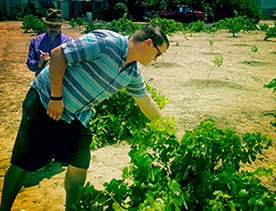
How could we not know of this vineyard? I don't mean that until now, no one knew about it, or that Jon Bonné had discovered it—the Galleano family have been its stewards for 3 generations. They have made serious wines from it for all of this time, and have sold grapes and wine to other California wineries that recognized its virtue—from all over California.
And Lopez is not alone: there is also the Galleano Home Vineyard and the amazing Hofer vineyard. But how could the rest of us have been unaware of these treasures? I feel as though we have a nearly civic duty to celebrate them, as we do the Declaration of Independence; and to support and honor the families that have kept them intact and have preserved them in the face of what would seem to be the ineluctable devastatation of suburban sprawl. This knot of vineyards too represents the remarkable intersection of a deep but nearly forgotten past and an almost unimagined viticultural and winemaking future—all within miles of Los Angeles.3
Soon after I spent a week in the Southland, I flew to London to support my partners in sales there, and I saw the tribe of New California wines in a radically different landscape. In California and much of the rest of the United States, we are regarded as renegades, and our work is seen as part of overturning. It is not necessarily the case that we, the winemakers, are overturning any paradigms—sometimes, it is the work of our supporters, the people who buy and sell our wines, who see their work as the overturning of an ossified, repetitive understanding of what is California wine. Sometimes the old paradigm is replaced by a a new one: over-oaked chard replaced by anything-but-chard; napa cab cast aside and trousseau gris sought out.
To some degree, what is lost is any discussion of excellence. That old, aristocratic, virtue is replaced by the celebration of lightness, freshness—younger, more democratic virtues. This is what was so interesting about being in London: there, wine culture is so rooted in age-old discussions of crus, grand crus, premier crus … There is an eagerness to see the new California not in rebellious, youthful opposition to this but as an extension of it. It is as if this were the second discovery of the potential for classical wines in California—a rediscovery of what Robert Mondavi had championed, now rooted in a new crop of wines from new places. What is wonderful for me is that this new crop is overwhelming London not with its mere difference, but with its excellence.
There is a real celebration of California terroir and a willingness, maybe even an eagerness, to see the possibility that California has vineyards the equal of some of those in Burgundy, the Jura, Etna… Let me put this another way: I had never expected to export wine to Europe. Why would they need our wines? This view is not limited to London, but I found a very focused attention to it there: "yes, we revere Clos St.Denis, but our pursuit of excellence is incomplete if we do not include Cabernets from the Santa Cruz Mountains, Chardonnay from Napa, even Verdelho from Lodi." They suspect, for the first time in a genearation, that there are vineyards in the US the equal of those ancient vineyards they already revere, and they want to come to know and celebrate them.
This is a wonderful, unexpected, thing to hear.
After London, I met Alex Pitts (now the assistant winemaker of the Scholium Project) in Vienna, to begin an extensive tasting of Austrian wines and three days of visits to vineyards and wineries. Austrian white wines have influenced, even guided, some of my winemaking since 2005, and I have craved the opportunity to visit the wineries and learn from the winemakers themselves. I learned two kinds of things on this trip, both of them very surprising to me.
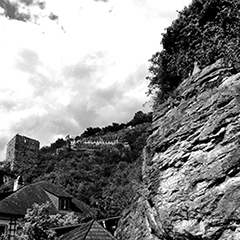
The first thing is hard to put into words, but is tangentially related to my experiences in London, and tightly related to changes we are seeing in American wine scene. I had not expected that it would turn out that those changes are not the least parochial but are part of a single wave with similar crests in many capitals. We met with the young winemaker of one of the most established domains in the Wachau, a winery in the pantheon of wine estates around the world. The wines are treasured and have always been praised for purity, clarity, expression of terroir. But they have also sometimes been passed by because of their intensity and richness. By "passed by" I do not mean faulted, but I do mean that as friends and colleagues have made decisions about which wine to consume on a given occasion, I have seen my friends pass by the wines of this winery in favor of other bottles, lighter, more delicate.
A friend in Austria had expressed this too: he said that he thought that the wines of the past decade, while wonderful, still “stuck in the throat.” It reminded me of judgments against the California wines of the 90s and 00s (and also against some of my own wines). And so it was so interesting to meet with the young, new, winemaker, who was guiding the wines in a new direction—not radically new, not in a rejection of the past, but in a tempering: a move away from power and toward delicacy. I was so impressed by the courage of the winemaker, and the confidence of the family who had given him the reins: even if some people in the stratosphere of aficionados were losing appetite for such wines, the reputation—and the fortunes—of the winery were built on a certain style. And now the whole operation was willing to walk away from that—not for commercial reasons, but to make what they all considered were going to be finer wines. They were doing it for the sake of excellence, and in the face of failure and rejection. I was filled with admiration. (We tasted the wines. The winery is succeeding brilliantly in its new aims.) The same impetus behind the New California evident in the heart and core of Austria.
Here is the second thing: We saw amazing vineyards—a jaw-dropping hillsides facing the twists of the Danube; beautiful, fertile, farmland harnessed through wisdom and the utmost care into grape growing; ancient hills of vines rising gently out of the bucolic environs of a capital city … The places were so distinct, so specific, that winemaking seemed inconsequential.
Yet we learned much about the practices of wineries we admired. We learned that in spite of the great stlystic similarity of many Austrian whites, there are (nearly) no rules. (Nearly everyone considers malo-lactic fermentation a kind of spoilage [in the way we first learned of from Stony Hill in Napa].) Some people favor whole cluster pressing, some destemming, some use a lot of SO2, some a little, some filter the shit out of the wines, a few would prefer to avoid filtration. But one winery, whose wines both Alex and I have deeply admired from the beginning of our educations, one winery both crushes and destems everything, and the results are brilliant, have been for decades, and persist in their ability to age and delight with age: the super traditional house of Knoll.4
We learned that until recently, from the era before the Second
World War until the
second
decade of the 21st century, this winery, paradigmatic of purity
and excellence, had
used
the same system for handling and pressing white grapes as our
friends and colleagues
at
Wooden Valley Winery have done and still do: a large and brutally
efficient
crusher-destemmer that can handle 50 tons per hour, and a must
pump that pumps the
resulting slurry into a 20-ton hydraulic screw press. This press
then presses the
slurry
against a fixed disk and squeezes the juice out of the sides of
the cylinder. Knoll
replaced this recently with a smaller, more gentle destemmer, and
two smaller, more
gentle
presses—but Emmerich assures us that they still proceed with
ruthless efficiency,
and
without excessive concern for delicacy. Seventy years of Knoll
were made with the
same
equipment used by the Wooden Valley Winery—the same equipment that
we used to
produce our
2006 Naucratis, 2006 La Severità di Bruto, 2007 La
Severità di Bruto
and
Dulcissima Camilla, and 2009 Naucratis. Brilliant, pure wines. The
connections
between
methods and results are inevitably hard to discern, much less
predict.
We find colleagues, mentors, models, support for what we do in many places, some distant and unforeseen: on the top of Atlas Peak, in San Diego County, in Durnstein on the Wachau … This is an honor, and the enterprise feels beautifully unbounded.