drought report
I do not want to say too much or speak in a mode that is too high-tragedy. Parts of our nation, to say nothing of the wide world, have suffered droughts for years. For two years recently, Georgia suffered a drought at least as bad as our present one. In late 2011, Texas began to endure a 14 month drought of unprecedented depth that caused billions of dollars of damage.
The difference in your mind and ours is perhaps that Georgia and Texas are not the homes of a charmed crop like wine grapes. Drought there does not capture the imagination in the same way. But you know enough already for your mind to leap way beyond this luxury crop to a concern that is much more fundamental: California is the home not only of wine grapes, but produces more of our national food supply than any other state; and produces more than three quarters of all of our lettuce, celery, broccoli, cauliflower, and one fifth of all of our milk. The drought is already having a brutal impact on our ability to produce these food crops, and no matter how much rain we might receive in the next few weeks, the impact of this winter's dryness will be felt until next fall at the soonest.
This is because California's climate is not only Mediterranean, it is Biblical and oscillates annually from a Sinai desert of absolute dryness to a Noachic rain forest. Only this year, we missed our forty days of rain. It was as if God had rewritten the celestial rules, and the worry is that the lack of rain was not an oversight, but a permanent revision to our covenant.
My inclination is to allow you to seek statistics elsewhere. Let me present you with an image, and then discuss briefly the impact of the drought on Scholium grape-growing and winemaking.
The image is of Brenna, above, standing in Steve Tenbrink's Pinot Noir vineyard. 21 days ago, before the burst of rain that we had in early February, there was nothing growing in the vineyard; the soil was barren, dry dirt. Now, three weeks later, there is a cover crop that comes up to her ankles. Thank God. In a normal year, say 2011, the cover crop would have reached her chest. Use this as a measure of the drought's effect. The rain that is not in our soil is also not in our mountains, locked in till summer as ice and snow. As that rain is missing now, the summer runoff we would normally expect will also be absent. Reservoirs empty now will never be filled; rivers low will never rise.
Here, in short, is what this means to us. Most of our vineyards go all the way through the growing season without any irrigation; some are completely dry-farmed, some get only a few gallons toward the end of the season. Most vineyards all around us are irrigated constantly, especially the vineyards that are sensibly devoted to making less special wines in larger quantities. Right now, these vineyards depend completely on irrigation to hit their standard yields. They will not come close this year. No one really knows what they will do. The economic impact of this in our industry will be measured in the lower billions.
Our vines, by contrast, are used to their summer Sinai. But that does not mean that they will sail through unscathed: they are also used to enough winter rain to support a thick and tall cover crop around them. This year, they will have been deprived of that winter water. They will go into the growing season having already survived a winter drought, and with no reservoir of soil moisture to begin their growth. We do not know enough to be able to foresee the effect of this precisely. It is unprecedented. I can tell you that when we prune Guman next week, we are planning to leave only half as many positions for fruit as we did last year. We are projecting a crop of 25 to 50 percent of last year's. On the other hand, the modestly dry winters of the last two years have shown us this benefit: the fruit that does grow should ripen more quickly and at lower potential alcohol levels.
This is the whole story. I will write back to you after fruit set, when we have some sense how much fruit is actually on the vines.
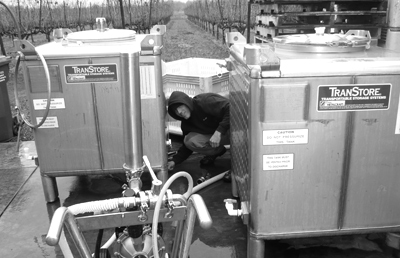
Let me tell you a side story of some irony. We have been preparing to bottle on Friday (and then to start shipping you wine a week later). I awoke two days ago to weather forecasts that had become certain: we will get a mini deluge on Friday, the biggest rain storm of the winter. We bottle out of doors; we have no way to shelter the operation. This amazingly welcome rain storm will postpone our bottling. We own no bottling line; we depend on a mobile line that is so much in demand that its schedule fills up a year in advance. We are somehow so fortunate: our bottling partners could reschedule us for Tuesday March 4—when the storm should have just passed. We have also had to reschedule labeling, and so we plan to begin shipping your wines now on March 12. You may still order packages of the Spring release here. It goes without saying that we will have much less wine to offer you next year, and probably the year after.
PS: here are some helpful links to information and discussion about the drought: