2005 Late Harvest December Notes
You will understand that it is difficult to update a website during harvest. These are my second and final notes of the harvest; I wrote these on the first day of december. And harvest is hardly over! We picked late-harvest red and white grapes just two days ago, and there still many red fermentations brewing. Not much red wine is in barrel yet.
the weather has been almost shocking. It is raining now—hard. The sky is dark all day, the wind blows doors opens, the sun seems to set just as you are starting work. This is the weather that we expect at the end of harvest. But a week ago, it was still summer. Grapes hung on the vine without threat of rain, rot, wind. We worked on the crush pad, and in the caves even, in shorts and tank tops. Fermentations sat outside warming in the sun, like cats. For weeks this weather held. This weather did not affect my grapes—I had picked all of my grapes by the beginning of november—but it both colored the way that harvest felt, and offered an odd, balancing counterpoint to the extended cool of the early fall. The result is that grapes were all perfectly ripe in an odd way—none had had a warm fall, so there was no raisining, no sunburn, no dessication. But neither did they have that intense push of furious heat immediately before harvest. There is good reason to believe some grapes–maybe cab and chardonnay—need this fury to obtain their expected ripeness. So we experienced utterly new heights, learned new lessons, this year: grapes that were perfect, but at a much lower degree of sugar than we are used to. The Hudson syrahs will barely reach 14% alcohol; the Margit’s cab, from a west-facing hillside, will display the unamerican frame of a 13.5% bordeaux.
“Dinner hill” is a name that is not long for the world. Sarah, the Scholium intern, and I somehow misunderstood it. It is the name of a neighboring vineyard, not ours. But we like the name so much, we cannot yet give it up.
The vineyard lies across a slope on the east-facing side of Sonoma Mountain. The vineyard is cool beyond expectation: no afternoon sun, and a diurnal blast of pacific fog through the notch in the hill above the vines … The soil is rocky, and supports a cover crop that smells more like a kitchen garden than a vineyard. The grapes, finally, are Sauvignon Blanc, and they are perfumed and rich to an uncommon degree. I harvested grapes from two different sections, three different clones, separated from each other by a week. The two lots are so different that they will make two different wines; the first: strict, particular, upright; the seond: voluptuous, redolent, large in frame . The individual barrels within both lots are oddly non-homogenous: some are quite dry and finished fermenting, some still rich and full of yeast.
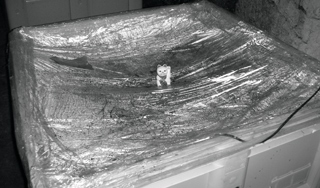
The vines at Margit’s face west; I was worried that the grapes on these old and rather sparse vines would roast in the afternoon sun. But instead, the west face absorbed cool Pacific breezes and the sun never began to burn this harvest. The tiny Cabernet grapes became perfectly ripe at the beginning of November: dark, intense, spicy–with the piercing acidity of of its ancestor, Sauvignon Blanc; not the otiose fatness of Cabernet from warmer lands. The caves were so cool by the time that we harvested the grapes that the small bins in which they were fermenting never became very warm. I worried for the yeasts, and felt great uncertainty before the tannins and pigments of Cabernet–they felt unknown to me. So in the bins went aquarium heaters, one to three for each bin. This is illustrated in the image above; together, of course, with a friendly and portable Fermentation God.
The wine is now consolidated into a single stainless steel tank, and finishing its fermentation very, very cooly; no heaters, and 45 degree temperatures at night. It seems right to complement the long, cool ripening of the grapes with such a finish to the fermentation.